
"For You" Sections
Introduction
Scenarios such as "Just For You" or "New Arrivals For You" suggest products that align with a user's specific interests, leveraging their past interactions on the site to determine the most relevant recommendations. In case of a new user without any previous recommendations, best-selling and trending products are offered.
Scenario Setup
In the Recombee Admin UI, navigate to the Scenarios section and choose Create Scenario.
- Enter a Scenario ID. Select a distinctive label for your recommendation scenario, such as "just-for-you"
- Choose Recommendation type - Items to User
Logic
The Logic defines the behavior of the recommendation engine.
- Choose the ecommerce:homepage logic type from the E-commerce models to give a personalized offering for the user
The Logic is also motivating the user to proceed with buying products that were of interest during previous visits.
Filters
You always want to recommend only the products that are in stock. Therefore you need to apply a Filter rule to allow only such products.
As it would be tedious and prone to error to add this rule to all the Scenarios, this rule shall be added to the Global Settings, so it is always applied everywhere.
You can select a predefined rule from the Recombee Library to allow only the available products.
Depending on how you represent availability in the catalog, it can be one of the following rules:
- Not deleted items - when you have a deleted property (true/false)
- Available items - when you have an available property (true/false)
- Items in stock [Google Merchant] - when you have a string available property with "in stock" as its value
You may want to add an additional New Arrivals box to your homepage with a personalized offer of the recently added products.
- Navigate to the Filters tab and Add first filter
- Find Recent items and click on +
- Specify which property in your Items catalog specifies the date of adding the product into the catalog
- Set the Number of days for which the new item can be recommended
For example, by setting 30 days, each user will get a personalized collection of interesting products that were added during the last month.
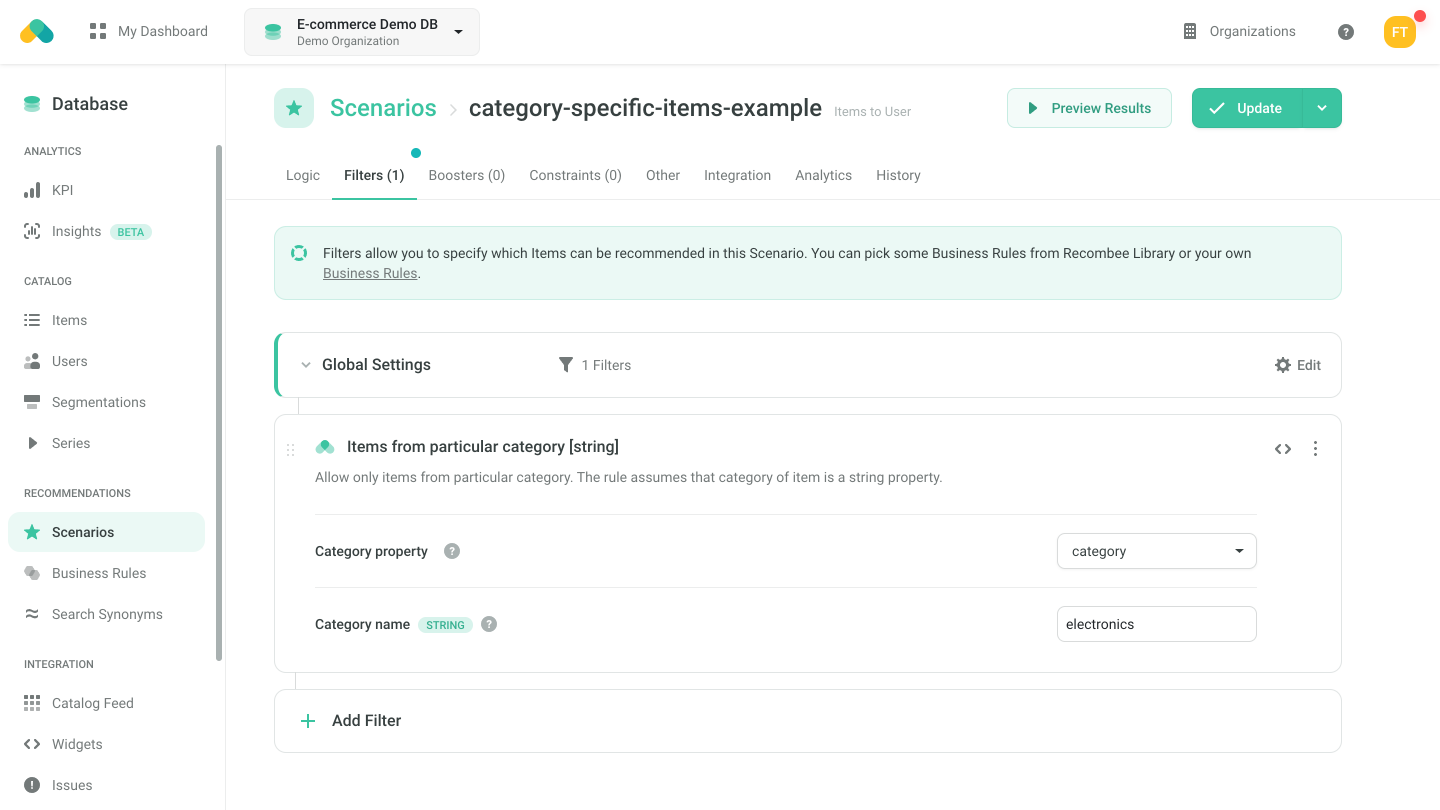
You may want to add an additional box to your homepage with a personalized offer of products from a particular category (e.g. “T-shirts you may like”, “Posters for You”, etc.).
-
Navigate to the Filters tab and Add first filter
-
Add one of the following filters from the library of predefined rules:
- Items from particular category [string]
- Items from particular category [set]
Used rule depends on whether your products have a single category or multiple categories per product in the catalog.
-
Specify which property in your Items catalog specifies the category
-
Set the name of the category
Boosters
You may want to bias the behavior towards a particular business or product goal - for example drive the recommender engine to push the items that are on sale more, because you want to completely sell out these products.
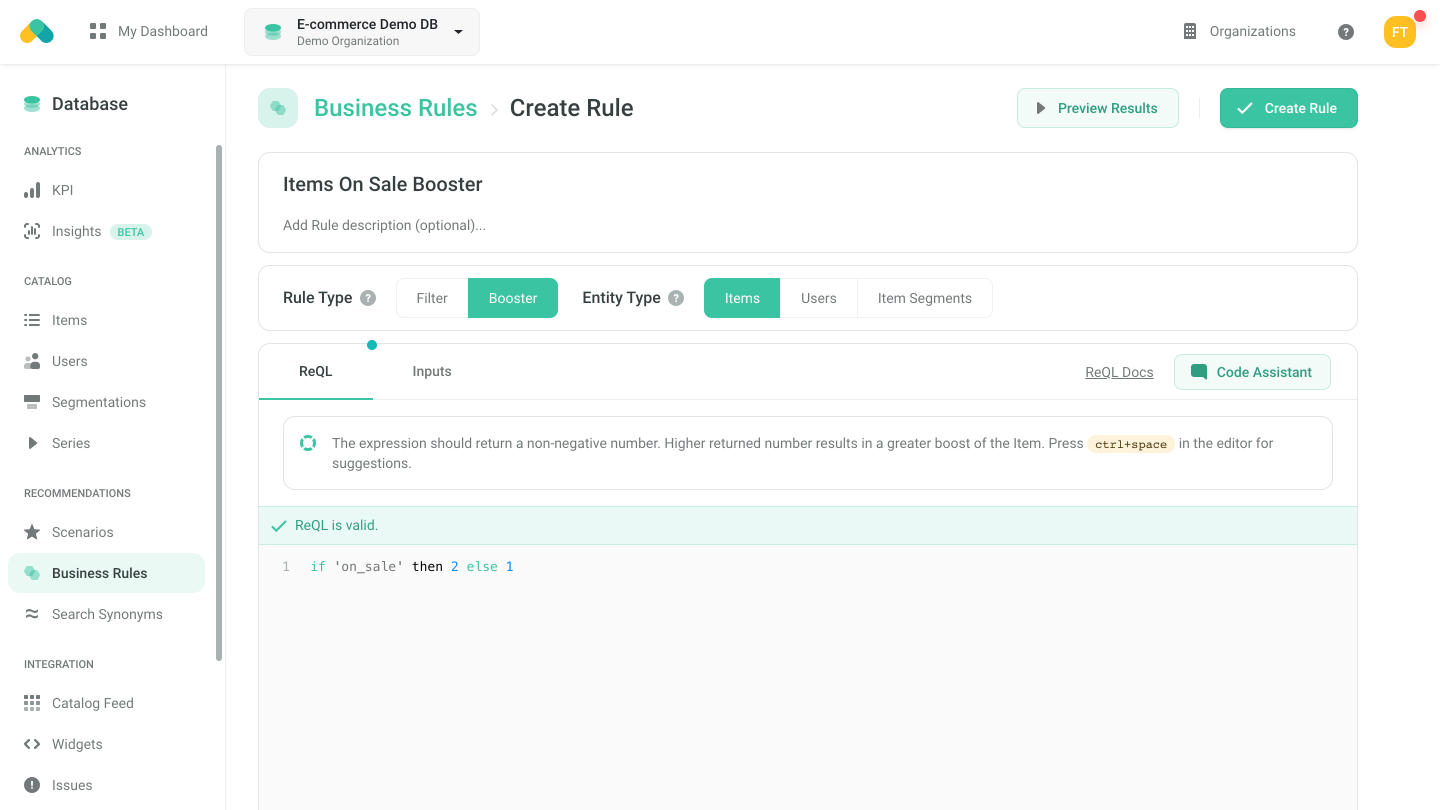
- Navigate to Business Rules section and Create Rule
- Enter a Rule name, such as "Items On Sale Booster"
- Choose Rule Type - Booster
- Choose Entity Type - Items
- Assuming you have an item property called on_sale, the ReQL expression can look like this:
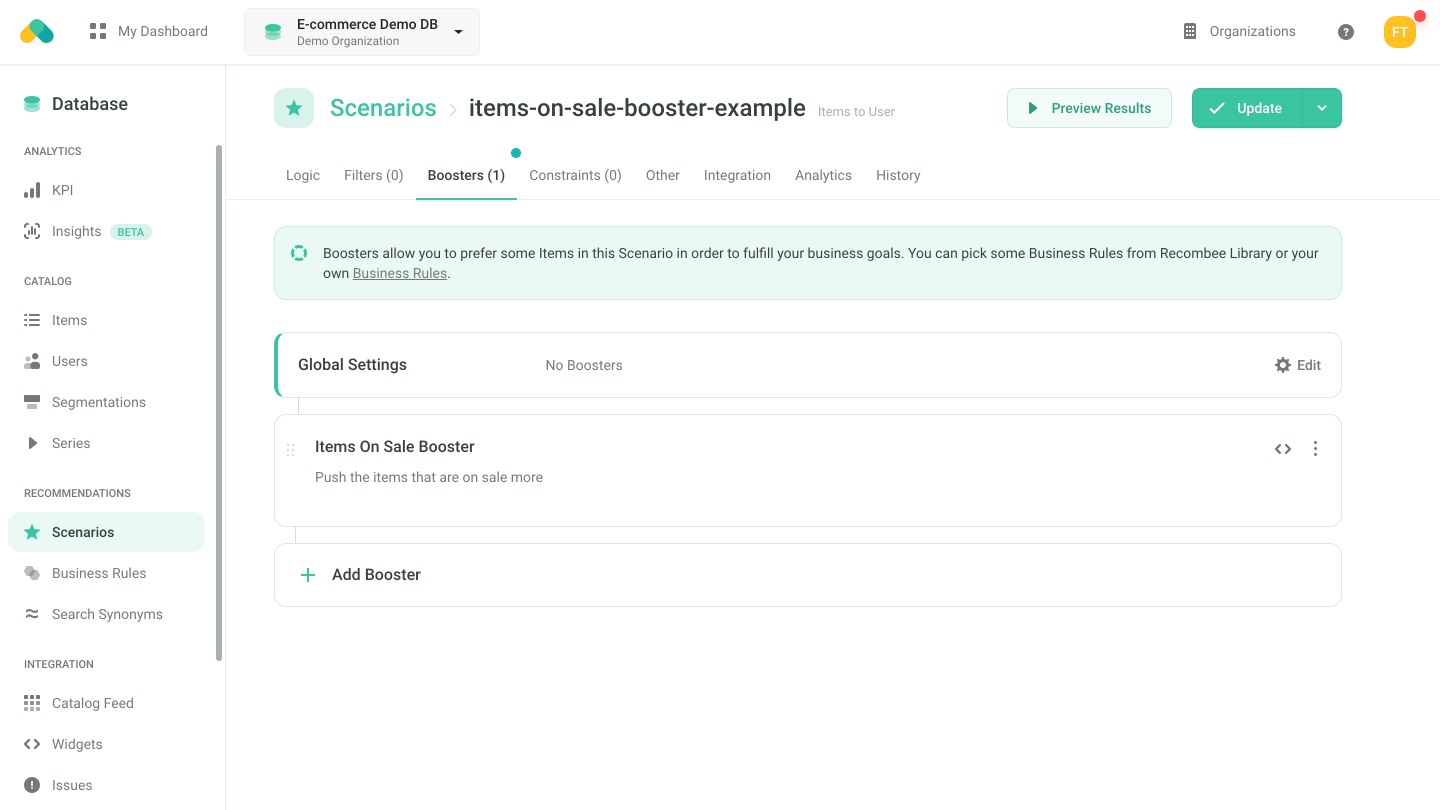
After creating the Booster, you can apply the rule to your Scenario in the Boosters tab.
Advanced tip: To easily test how much the items shall be boosted, you can introduce a Boosting Coefficient Input Value and use it in the ReQL:
Then you can set the coefficient directly in the Scenario screen and find the most fitting amount of boosting using the Preview Results function.
Requesting Recommendations
There are three ways to get recommendations.
- No-Code Widget - create a No-Code Widget using the visual editor in the Admin UI.
- Widget SDKs - use the SDK for a Carousel, Grid or Feed to display the recommendations in the design of your choice. Use the Recommend Items to User endpoint when initializing the widget.
- API SDK - request the Recommend Items to User endpoint of the Recombee API using an SDK of your choice.
For more information, navigate to the Integration tab of the Scenario in the Admin UI.
In order to request content for multiple homepage boxes with a single API request, use the Batch endpoint and put the recommendation requests inside it. Set the parameter distinctRecomms in order to deduplicate the items among the boxes.