
Personalized Emailing
Introduction
Personalized emailing is essential for e-commerce, ensuring customers receive content that reflects their interests and behaviors, thereby boosting engagement and conversions.
Scenario Setup
In the Recombee Admin UI, navigate to the Scenarios section and choose Create Scenario.
- Enter a Scenario ID. Select a distinctive label for your recommendation scenario, such as "email" or the name of the particular emailing campaign
- Choose Recommendation type - Items to User
Logic
The Logic defines the behavior of the recommendation engine.
- Choose the recombee:emailing logic type from the Universal Models
This model is fine-tuned for periodic (e.g. daily) personalized emailing campaigns.
The rotationPolicy parameter specifies how the recommendations for the user change with each subsequent email sent.
By default, there is a smart rotation that takes into account the position of recommended items and allows some of the items to re-appear in further e-mails.
If you prefer not to repeat a recommended product in the emails ever again, you can set the parameter value to total.
By default, rotation only takes into account recommendations (e-mails) at most 14 days old. Should a longer time period be needed for your use case, kindly contact support@recombee.com.
Filters
You always want to recommend only the products that are in stock. Therefore you need to apply a Filter rule to allow only such products.
As it would be tedious and prone to error to add this rule to all the Scenarios, this rule shall be added to the Global Settings, so it is always applied everywhere.
You can select a predefined rule from the Recombee Library to allow only the available products.
Depending on how you represent availability in the catalog, it can be one of the following rules:
- Not deleted items - when you have a deleted property (true/false)
- Available items - when you have an available property (true/false)
- Items in stock [Google Merchant] - when you have a string available property with "in stock" as its value
You may want to create an emailing campaign dedicated to recommending the newly added products.
- Navigate to the Filters tab and Add first filter
- Find Recent items and click on +
- Specify which property in your Items catalog specifies the date of adding the product into the catalog
- Set the Number of days for which the new item can be recommended
For example, by setting 30 days, each user will get a personalized collection of interesting products that were added during the last month.
An alternative to this approach would be adding the Boost recent items booster instead of a filter - especially if you don’t add new products continuously, so there might not be always a sufficient number of candidates.
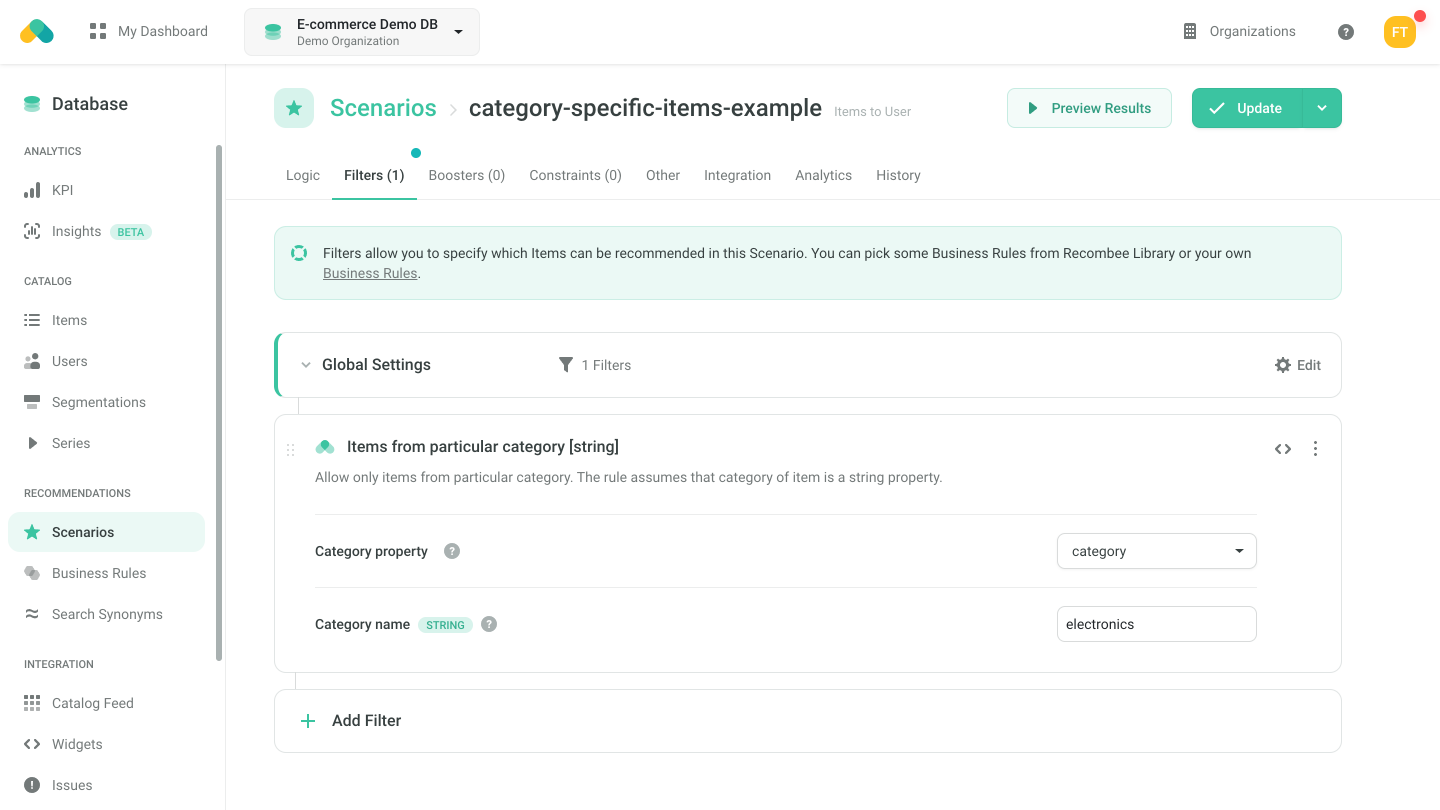
You may want to create an emailing campaign dedicated to products from a specific category.
-
Navigate to the Filters tab and Add first filter
-
Add one of the following filters from the library of predefined rules:
- Items from particular category [string]
- Items from particular category [set]
Used rule depends on whether your products have a single category or multiple categories per product in the catalog.
-
Specify which property in your Items catalog specifies the category
-
Set the name of the category
Boosters
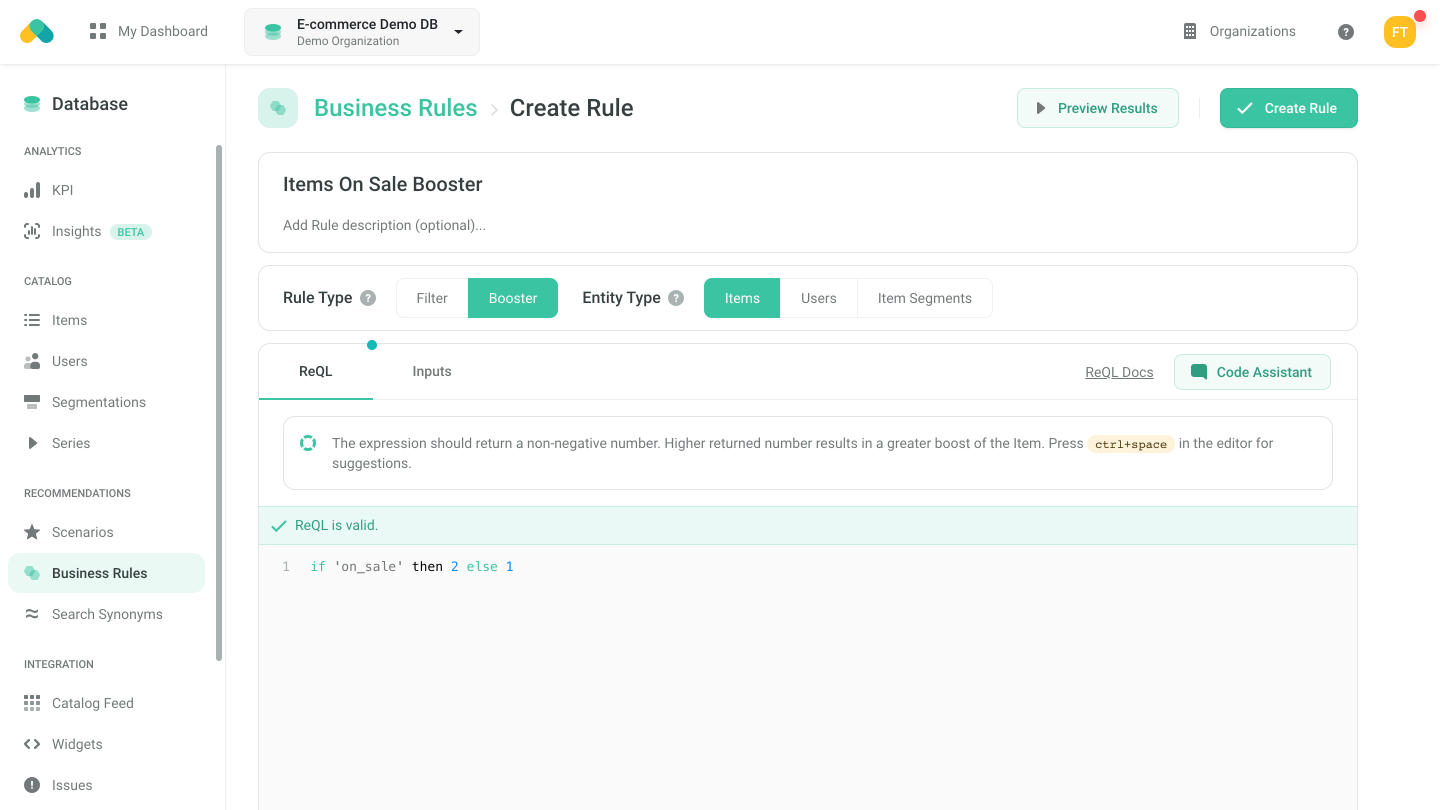
You may want to bias the behavior towards a particular business or product goal - for example drive the recommender engine to push the items that are on sale more in the sent emails, because you want to completely sell out these products.
- Navigate to Business Rules section and Create Rule
- Enter a Rule name, such as "Items On Sale Booster"
- Choose Rule Type - Booster
- Choose Entity Type - Items
- Assuming you have an item property called on_sale, the ReQL expression can look like this:
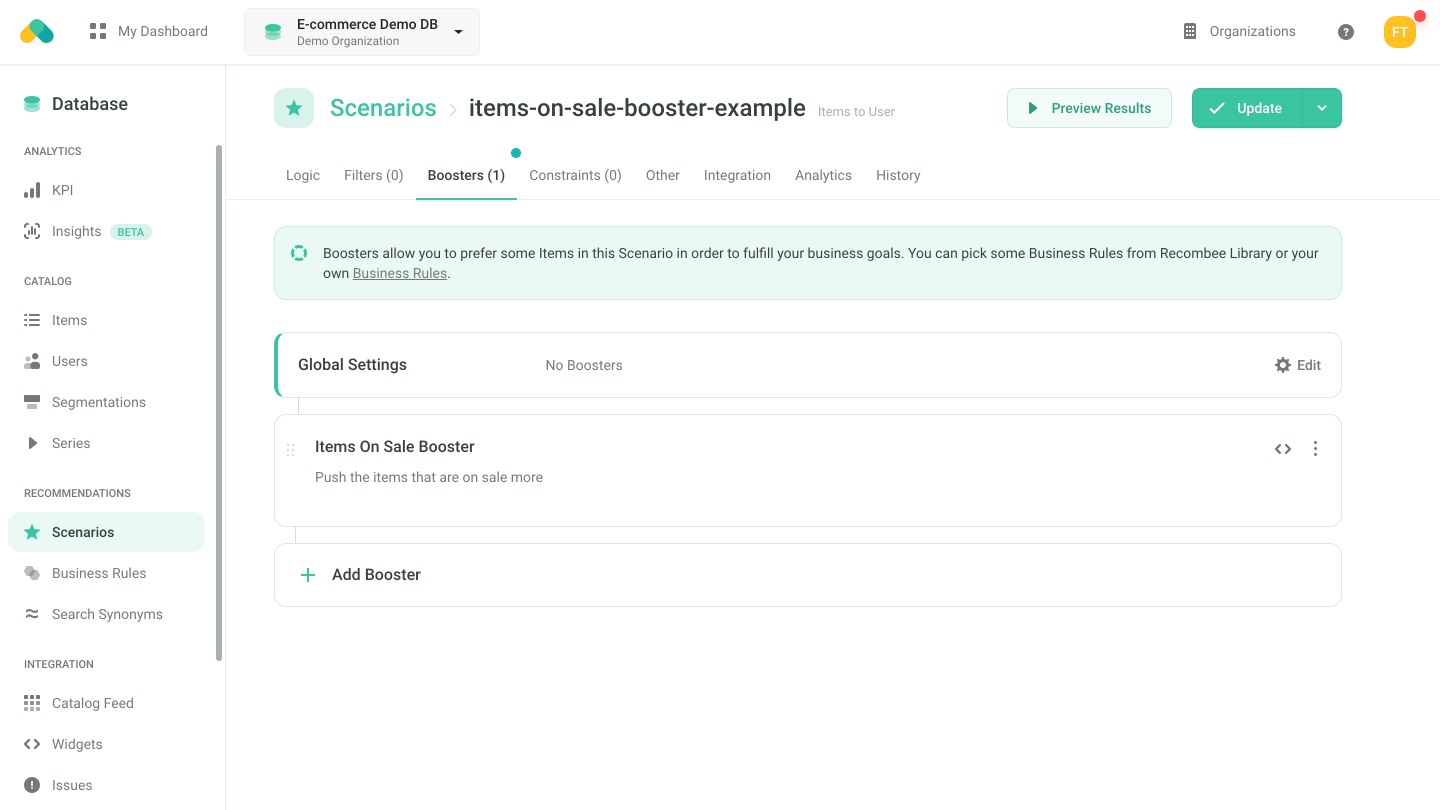
After creating the Booster, you can apply the rule to your Scenario in the Boosters tab.
Advanced tip: To easily test how much the items shall be boosted, you can introduce a Boosting Coefficient Input Value and use it in the ReQL:
Then you can set the coefficient directly in the Scenario screen and find the most fitting amount of boosting using the Preview Results function.
Requesting Recommendations
Choose the way of requesting recommendations compatible with your emailing platform
Requesting Dynamic Content from API
If the emailing platform can fetch the recommendations directly from the Recombee API:
- Ensure the platform supports the authentication scheme directly (e.g. in the case of Customer.io), or set up a small proxy that authenticates the requests.
- In case the authentication proxy needs to be set up, please contact support@recombee.com for guidance on how your emailing platform can be connected with Recombee.
Pre-fetching Recommendations
If the emailing platform does not support requesting a 3rd party API but supports adding personalized content unique to each user:
- Request the recommendations for each user who shall get the email using the Recommend Items to User endpoint.
- Upload the recommendations to the emailing platform.
- Send the emails.
You can even request many recommendations at once using the Batch endpoint.
You can contact support@recombee.com to get more information on how this procedure shall be implemented in the case of your emailing platform.