
User Documentation
API Clients & Integrations
Scenario Recipes
The first part of the tutorial covers sending interactions to the system and getting recommendations based on them.
Suppose that I run a website which offers tickets to cultural events and I already have some collected data from the past - namely views of the events and purchases of the tickets by the users. For simplicity, I have the interactions in two .json files with the same structure.
We will use SDK for communication with Recombee, as it greatly simplifies the process of the integration. I need the Recombee client, so we will import it from the already installed package. We will also import all the classes for the requests in order to spare some typing. Then, I create the instance of the client. It is initialized with the ID of my database and the secret token, which I both gained when I created the instant account, so we will just copy and paste them from the UI at admin.recombee.com.
Now, I want to upload some interactions to the recommender system. We
will start by reading and the purchases from the json file and creating
an AddPurchase
request object for each purchase in the file. It takes two mandatory
parameters - the userId and the itemId. We will set the optional
parameter timestamp to time, because the default value is the
current time, but I want a particular time from past. And we will also
set cascadeCreate to true in order to create in the system the yet
non existing items and users.
I could send the purchases one by one, using the send method of the client.
Sending individual requests is very beneficial when you have the recommender already deployed in production as the system can immediately modify its recommendations using the just received interaction.
But uploading larger data from the past with individual requests would be quite slow, so for sending the list of purchases we will use the Batch request, which can encapsulate many requests into a single request.
Now let's run the script and see the result in the Admin UI.
You should see the uploaded items in the Catalog listing. You can also check interactions of an item by clicking its id.
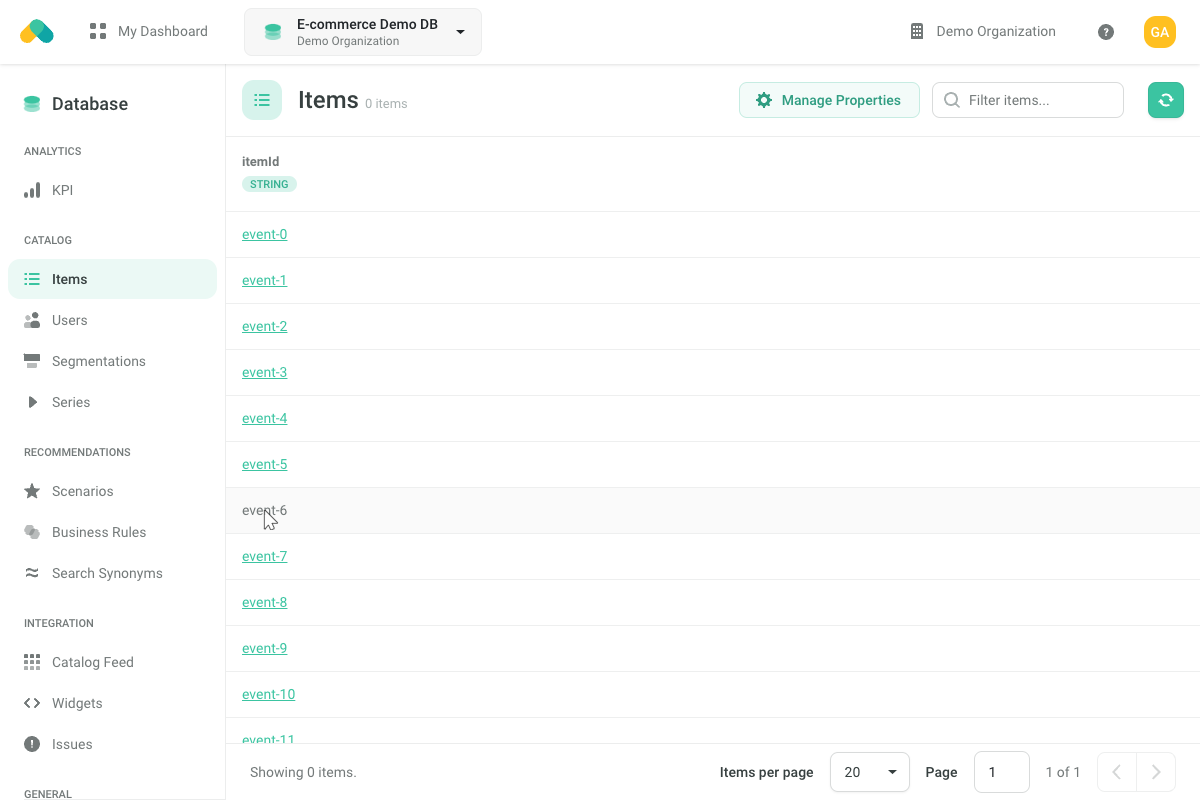
Now I'll change the code to send the detail views by changing the name of file with interactions (purchases.csv to detail_views.csv ) and the name of the class from AddPurchase to AddDetailView.
After running the changed code, detail views should appear in the interface.
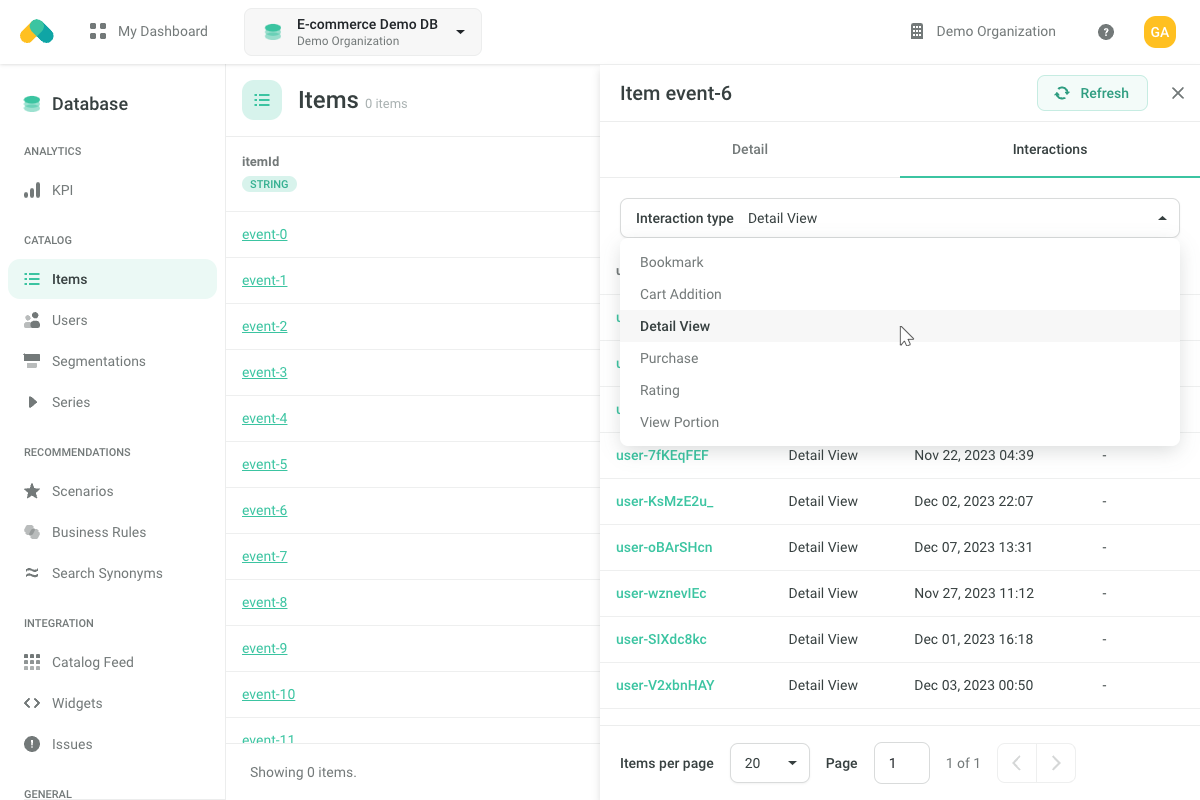
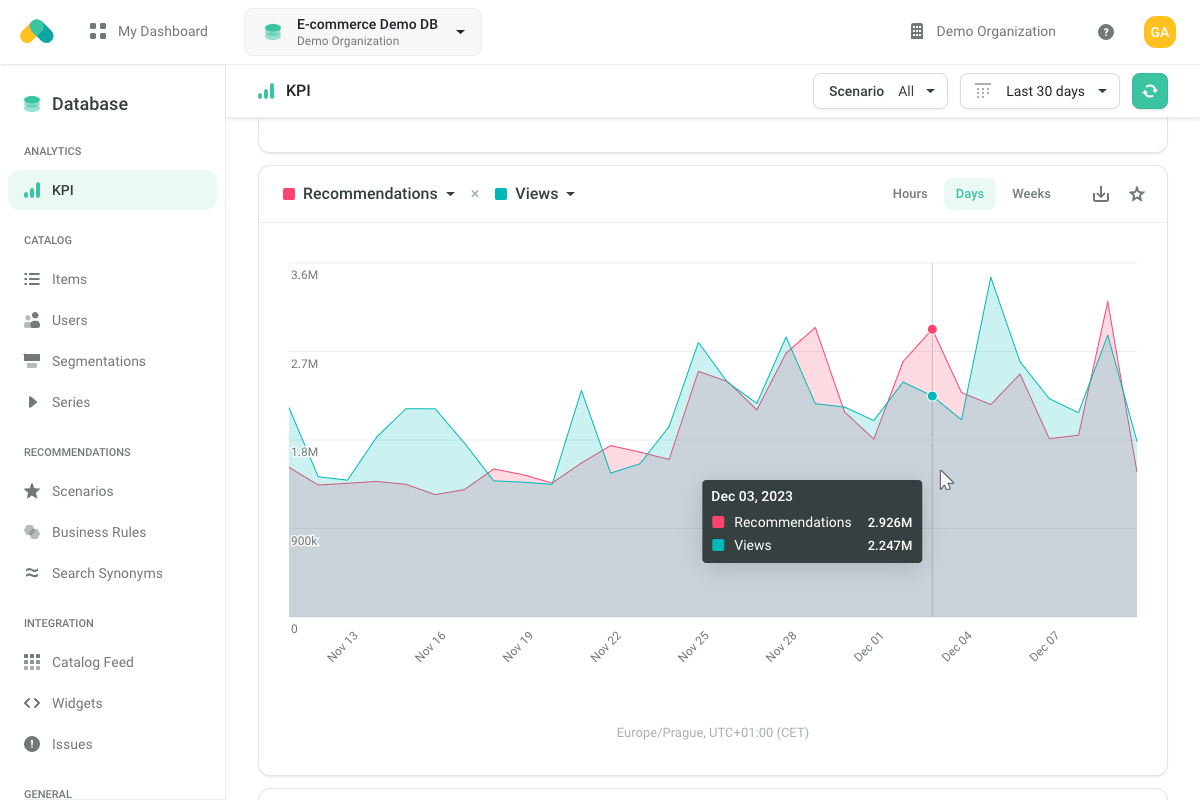
You can also see the visualization in the KPI console, which is updated up to every few minutes.
Now it's time to get some recommendations based on the uploaded interactions.
Suppose that user-27 just came to my website. I want to immediately show him 5 events that he will most likely favor. I'll use the RecommendItemsToUser for this task.
An object with recommended items in field recomms is returned. For
example:
Now I can show these recommended events to user-27 at my homepage.
Let's say that the user likes the recommended events, and clicked one of them, namely event-32, to see the details. The page of the event contains box with related events, which are obtained by requesting the RecommendItemsToItem. The id of the user is passed in the request as well, to make the related items personalized for user-27.
Returning:
Other two supported recommendation endpoints, RecommendUsersToItem and RecommendUsersToUser return users instead of items. For example if I want to know which users would be most likely interested in attending event-42, I'll call the RecommendUsersToItem.
Returning:
As you can see sending interactions and getting recommendations is very easy, and took just few lines of code. In the next tutorial I'll show you how to send properties of the items to Recombee and how to use these properties in filtering and boosting according to your business rules.
Items in the Recombee system can have many properties such as title, description, categories, price and many other. There are two possibilities how to get your items catalog into Recombee - one is setting a catalog feed and the other is uploading the data from your server. This tutorial covers the second option.
Let's continue with the sample company that sell tickets to cultural events from previous part of the tutorial.
The events have following properties:
| id | name String | city String | venue String | genres Set | date Timestamp | price Double |
|---|---|---|---|---|---|---|
| nyphilharmonic181210 | New York Philharmonic: Rachmaninoff | New York | Lincoln Center | ["classical music"] | 2018-12-10 19:00 | 94.0 |
| beachboys190321 | Beach Boys | New Jersey | Arts Center | ["rock music", "rock’n’roll music"] | 2019-03-21 20:00 | 69.0 |
| snoopdogg191102 | Snoop Dogg | New York | Terminal 5 | ["hip-hop", "rap"] | 2019-02-11 19:00 | 42.0 |
I have these data in a json object, where the keys are IDs of the items and values contain an object with item properties.
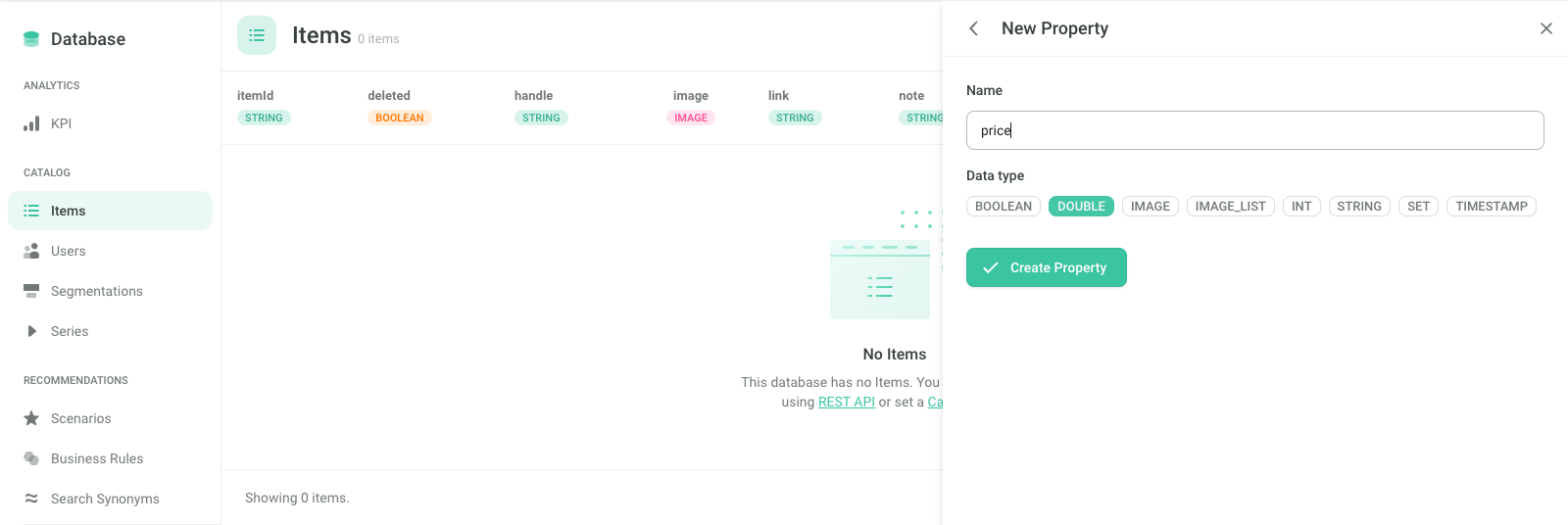
Now, let's see how we can send these data to Recombee, and how they are used in recommendations. First, I need to define the properties. They can be thought as columns in relational database. In my case the properties are title, city, venue, date, genres and price.
I add them using the Admin UI:
Alternatively, I can add them by calling the API:
The properties are now in the place. If there were already some items in
the database, they would have all the values set to NULL.
I start by reading the file, parsing the json and iterating over the
item IDs and corresponding property values. I will send them to Recombee
with SetItemValues requests.
SetItemValues takes the itemId, the property values of the items, and the
optional parameter cascadeCreate which I set to true in order to create items
in the system if they don't exist yet. I use the Batch to speed up the uploading.
I can check the uploaded items in the Admin UI.
Other properties that are usually very useful, but were not included in this example are text descriptions, which are processed by text mining algorithms, and links to images (property types Image and Image List) that can be used for finding visually similar items using artificial neural networks and other images processing models.
ReQL filtering allows you to put some restrictions on the recommended items.
You can use ReQL also for specifying the Business Rules in the Admin UI
Let's assume I have the catalog of cultural events from previous part of the tutorial uploaded in my database. It contains following item properties: title, city, venue, genres, date and price.
I want to get some related items to item nyphilharmonic181210, which is concert by the New York Philharmonic. These recommendations will be shown to user-27. I use RecommendItemsToItem for this purpose:
I got some IDs, but in order to evaluate the quality of the
recommendations, I need to set optional parameter returnProperties to
true.
Now I get also the property values of recommended items. As you can see, the recommended items look pretty related to the concert of the philharmonic.
But if the user is interested in the New York Philharmonic concert which takes place in New York City, there is only slight chance that the user will attend concert of Los Angeles Philharmonic in LA.
So I want to put restriction on the recommendations to return only
events that take place in New York. This can be easily done by setting
filter 'city' == "New York".
As you can see I use single quotes for accessing values of the properties and double quotes, which I had to escape, for creating the New York string.
Now all the events I received take place in New York:
The problem is that some events may have already passed, and therefore should not be recommended. To filter these events out I compare the date property with current time, which obtain by calling ReQL function now().
The filter therefore becomes 'city' == "New York" and 'date' >= now():
Now all the events are upcoming. Another restriction can be restriction
on genres - let's suppose the user chose to view only items that have
ballet as one of their genres. It is done by appending
"ballet" in 'genres' to the filter:
Sometimes the filter may depend on the currently viewed item. For example, we may want to change our filter not to permit only items from New York, but recommend events from the same city where the event that is currently viewed by the user takes place.
The context_item function, which retrieves properties of current item, makes achieving
this behavior easy. We will permit only items that have the same city
as context item: 'city' == context_item["city"]. Therefore if we get
recommendations related to an event that takes place in Los Angeles,
we get only events taking place in LA.
As you can see, the possibilities of filtering are very broad. Besides filtering, there is also the possibility to boost some items or use properties of users.
To see the steps required to integrate Recombee with your website or JavaScript application, please refer to the example in our JavaScript SDK Documentation.